Step 6: Urban design
| URBAN DESIGN PARAMETERS | DESCRIPTION |
|---|---|
| Built form | Buildings and man-made structures. |
| Bulk | The combined effect of the arrangement, volume and shape of a building. Also referred to as massing |
| Form | The layout (structure and urban grain), density, scale (height and massing), appearance materials and details) and landscape of the development. |
| Definition |
Urban form elements and arrangements to define, demarcate or distinguish zones, spaces and areas. Definition can be achieved through a variety of means including through:
|
| Height | The height of a building in number of storeys from ground level. |
| Façade and interface | The relationship of buildings to the site, street and neighbouring buildings in terms of: Alignment Setbacks and boundary treatment Architectural expression of their facades including projections, patterns, openings and materials |
| Urban grain |
The balance of open space to built form, and the nature and extent of subdividing an area into smaller parcels or blocks.
|
| Plot ratio | A ratio representing the density of building in a specified area of land. Expressed as GLA in relation to the size of the plot. |
| Public realm | The public realm includes the natural and built environment used by the general public such as streets, squares/plazas, promenades, parks, and public infrastructure. Much of urban design is concerned with the design and management of publicly used space and the way this is experienced and used. |
| Scale (height and massing) | The scale of a building in relation to height and floor area, and how it relates to surrounding landforms, buildings and streets. It also incorporates building envelope and site coverage. Height and massing create the sense of openness or enclosure, and affect the amenity of streets, spaces and other buildings. |
| Setbacks | A setback refers to the distance that the building or structure must be from the front, sides, and back of the property line. |
| Materials and details | The appearance of structures, objects and surfaces and the selection of materials in terms of detail, craftsmanship, texture, colour, durability, sustainability and treatment. It also includes paving street furniture, lighting and signage. It contributes (or impairs) human comfort, safety and enjoyment of the public domain. |
Key urban design objectives
The key urban design objectives will be informed by the precinct vision and stated objectives, and will typically include the following urban objectives:
The range of built forms must take account of the desired development targets in terms of massing, land use mix and residential densities and must also correspond with and inform block and stand sizes.
- Design the built form to be adaptable to future changes in land use as a result of changing technological, social and economic conditions and preferences (see Case Study 5 below).
- Consider the upgrading and / or repurposing of existing buildings, infrastructure and other structures to fit the vision and objectives for the precinct. Pay special attention to the following:
- Heritage assets that may contribute to the desired precinct character, noting that some heritage assets require some modification to be fully accessible to all people, including people with disabilities
- Adaptive reuse of especially warehouses and factories is a popular intervention in industrial areas or areas urban renewal or upgrading. They offer the opportunity to restore and preserve beautiful old design and incorporate it into a modern architectural landscape, re-invigorating and enriching the area
- Abandoned infrastructure assets that may be repurposed, for example the New York High Line park and Orlando Cooling Towers
Shopping malls proliferated in the urban environment over the past few decades. They are now increasingly being challenged for share of the consumer’s wallet by e-commerce. In the US, Amazon is aggressively acquiring and repurposing shopping malls as warehouses and distribution centers within their supply chain. Between 2016 and 2019, Amazon converted around 25 shopping malls, according to an analysis by Coresight Research. For example, Amazon won approval in March 2021 to turn a shopping mall in Baton Rouge, Louisiana, into a 315 870 square meter distribution building.
Urban design should be responsive to climatic conditions and design spaces for water capture, reduced energy consumption, infiltration of rainfall and resilience in the face of climate change risks and shocks. Consider the following (not an exhaustive list):
- Sustainable Drainage Systems (SUDS) mimic natural drainage patterns and can reduce surface water runoff, encourage recharge of groundwater, and provide amenity and ecosystem enhancements. Some options include:
- Permeable and porous pavements.
- Distributed rainwater harvesting.
- These are vegetated landscape features with smooth surfaces and a gentle downhill gradient
- to drain water evenly off impermeable surfaces.
- Infiltration devices, such as soakaways that enable allow water to drain directly into the ground.
- Green roofs and reuse of water.
- Ponds and other stormwater retention structures designed to hold water when it rains.
- Consider multi-functional design, for example, urban parks offer opportunities for relaxation and recreation and adds to the attractiveness of the area. But parks can also be designed for carbon trapping and improved stormwater management.
- Building orientation, siting and layout affects the thermal performance, comfort and amenity of buildings.
- Site buildings for optimal solar orientation, having use regard with streetscape and character requirements.
- Building heights: be mindful for overshadowing of some buildings on other buildings and spaces that may limit their sunlight, views and own ability to generate solar energy.
- Natural ventilation and wind impacts: Building placement, layout, orientation and separation all affect air flow, natural ventilation as well as wind effects at street level.
- Consider the need for weather protection from the elements (sun, wind and rain) e.g. shaded facades, colonnades, bus shelters etc.
- Vegetation can increase the attractiveness of the precinct and provide cooling in two major ways. Tree canopies providing shading and reducing surface temperatures by intercepting solar radiation. Evapotranspiration lowers air temperature while increasing humidity.
- Consider opportunities for distributed rainwater harvesting and reuse, where possible.
- Consider, with due regard to local character, community culture and social systems, opportunities for urban gardens, vertical gardens and roof gardens.
- Adopt water sensitive practices that integrate water cycle management with urban planning and design processes.
Height control
- Land use requirements and densification targets established for the precinct.
- Avoidance of any potential losses in environmental quality such as blocking of views, sunlight, and natural breezes; trapping of air pollution near the streets, or the creation of urban heat islands.
- Calibrate building heights in relation to surrounding buildings, natural features, heritage assets and importantly, the streetscape.
- The ratio of building height to stand size.
- Moderate building heights in The Heart, Activity Corridors and Transition Zones, ensuring accentuated transition into neighbouring areas.
Setbacks
- Setback requirements can be established at both street level and for upper storeys. In general, tight setback controls are required in precincts for all non-residential land uses at ground level to establish a strong street edge and direct relationship between the commercial ground floor uses and the street. In residential streets setbacks controls are relaxed to provide some privacy and to enable landscape screening and beautification.
- Setbacks at upper storeys affect the height-to-width ratio of a street to achieve perceived pedestrian scale and also sunlight penetration.
- Managing character for example by establishing a consistent building line, or to articulate building frontages to add interest.
- Managing views and vistas.
- The need to retain trees or plant trees.
- Sidewalk functional and activity requirements.
- Avoid and design for the elimination of negative spaces.
- Develop specific urban design interventions for known and perceived crime hotspots as identified in the status quo assessment.
- Maximise opportunities for natural surveillance, from both sides of the street, and at multiple vertical levels.
- Wider sidewalks coupled with mixed use and longer operating hours deliver more vibrant streets that act a deterrent against crime.
- Where appropriate, design for defensibility.
- Pay particular attention to lighting arrangements.
Consider the following (not an extensive list):
- Legibility analysis has been conducted as part of the precinct status quo analysis. Consider the outcomes of the legibility analysis and identify areas where legibility needs to be improved.
- Legibility can be improved by employing Lynch’s 5 elements of paths, nodes, landmarks, edge and districts.
- Establish clear and defined entrances to the precinct, for example through signposts and creating pinch points – this may also be done for sub-precincts and character areas.
- Create well-structured paths.
- Design for clear sight lines.
- Create areas within the precinct that visually differ in character.
- Create an unique identity at each key location.
- Use key landmarks and where they do not exist, consider creating landmarks through the installation of urban art and other recognisable structures and features. Landmarks should be positioned at points within the movement network where they can aid orientation and navigation.
- Structured landscaping can create edges for definition and orientation.
- The location of key distinctive buildings and taller buildings within the precinct to aid orientation.
- Provide signs at decision points to help wayfinding decisions. Signs can include physical signage, electronic signage, use of landmarks for orientation aids, and tactile features for the visually impaired.
- Don’t clutter signage to avoid confusion.
- Ensure that signage is not hidden or obscured by other features or structures.
- Specifically consider wayfinding solutions for the disabled, the elderly and the very young.
- The Heart should be characterised by entrances to buildings opening directly off the street. Buildings should not be isolated through car parks or access roads.
- Entrances to buildings should be located in high visibility locations such as corners or alternatively designed as welcoming spaces that people can clearly understand as the main access points to their intended destinations.
- Privacy requirements
- Security requirements
- Access requirements (loading and unloading, emergency services)
- Servicing requirements
- Natural light and ventilation requirements
- Health and safety requirements
This section focusses on how the urban block can be conceptually managed spatially to accommodate a mix of land uses in the horizontal plain across the precinct and within the urban block itself considering some of the requirements listed above.
| NOTE | |
|---|---|
| The same considerations will apply to a scenario where land uses are mixed vertically, however the primary informant for mixing land uses vertically will be to optimise the public interface for the purpose of enlivening and increasing passive levels of surveillance over the street spaces. This is expanded on the following section on ‘Making the public realm’ | |
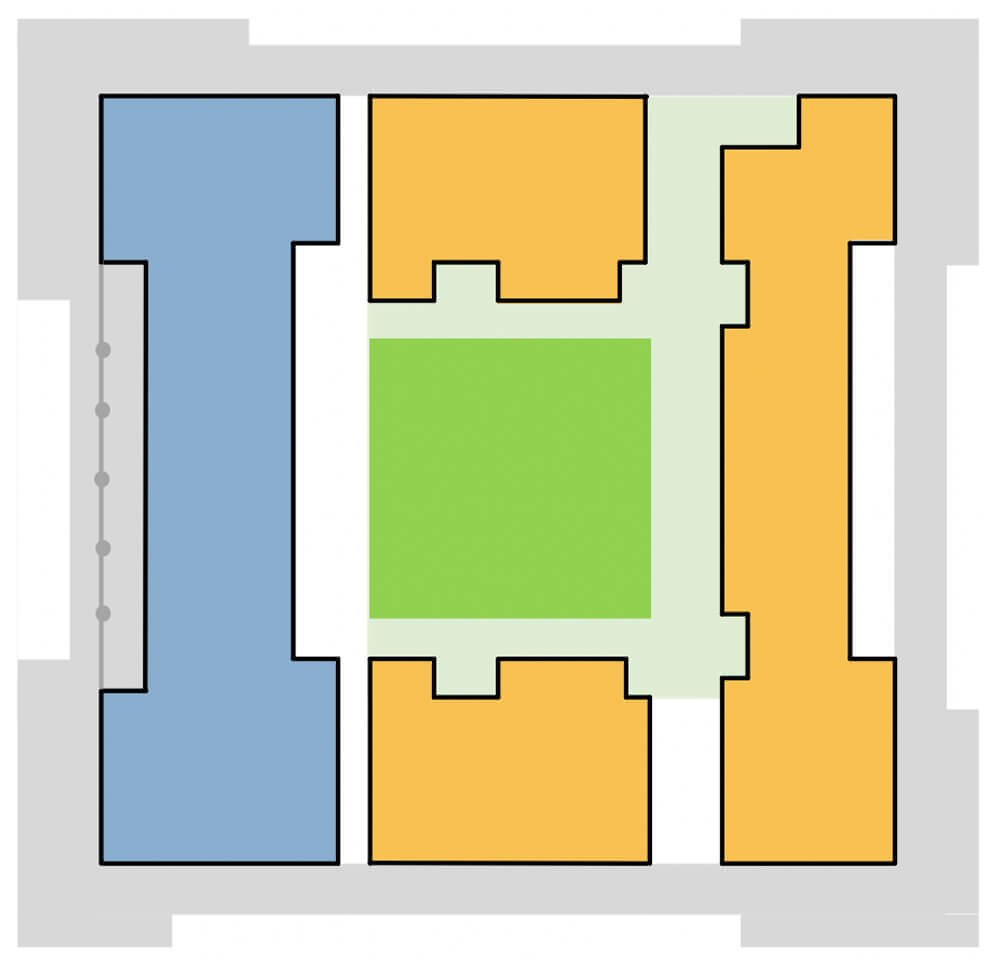
Type B does not preclude stacked units, but it generally doesn’t allow more than about two to three storeys of units in total. The perimeter type block arrangement can therefore accommodate much higher densities. Regardless of the type of units and arrangement there are certain guidelines that need to be used to ensure that residential development can comfortably exist within an intense mixed-used environment.
- Create semi-private shared space for residents internal to the block where possible.
- Provide sufficient space at the interface (back and front) to achieve the necessary privacy gradient.
- Locate pedestrian entrances at points of high visibility/connectivity.
- Locate parking in small planted courtyards within the block or between blocks and in limited lengths along the street.
- Where courtyards are created internally, make sure that the building height to courtyard area is the right ratio to allow adequate levels of sun and light in. Conversely, make sure the courtyards are sufficiently defined to create a sense of enclosure.
- Where courtyards are created, use the building as the security line to avoid the need for high fences/walls.
- Where there is a range of different size operators/tenants, allow smaller operators to locate on the most exposed street edges and along internal pedestrian routes to maximise on visibility and access.
- Allow a finer scale penetration of blocks for pedestrians.
- Limit the extent of the service interface for large tenants on the street.
- Limit the amount of at grade parking, locating it rather below ground, or in limited lengths along the street edge.
- Align main pedestrian entrances with corners or other highly visible or accessible points on the periphery of the block.
- Integrate PT stops where possible into the edge of the building where blocks edge important PT routes.
- Where internal courtyards are created, make sure that the building height to courtyard area is of sufficient ratio to allow adequate levels of sun and light. Also make sure that courtyards are sufficiently defined to create a sense of enclosure.
- Where courtyards are created, the building itself must be used as security line to avoid unsightly high fences/walls.
- Where spaces on ground floor have two public interfaces consider how servicing of the units can happen without compromising the quality of the courtyard and street.
- The interface condition between the different land uses should be carefully negotiated especially with regards to servicing and access requirements.
- Where internal courtyards are created, make sure that the building height to courtyard area is of sufficient ratio to allow adequate levels of sun and light. Also make sure that courtyards are sufficiently defined to create a sense of enclosure.
- Where courtyards are created, the building itself must be used as security line to avoid unsightly high fences/walls.
The nature and location of the service entrances especially where there is the potential to make a positive people-friendly inner courtyard.
Carr Gardens incorporates a 1922 police station that is a historic monument to be preserved. The offices of the old police station were converted into residential units and those around its inner courtyard today house the children’s crèche and playground established by the JHC – a mark of the company’s drive towards inner city transformation and renewal. The development features secure courtyard parking, internal landscaping and children’s play facilities.
- To prepare urban design frameworks for each of the respective sub-precincts including layouts and typical interface conditions that demonstrate what the expectations are of developers/public sector occupants.
- To prepare a set of design guidelines for the Urban Hub comprising hard and soft landscaping details and specifications where necessary.
The activities contained within the built edges that define the public realm and the form of the interface, are important when considering urban performance. It is for this reason that the following focusses on both land use aspects and formal aspects of design associated with the public interface.
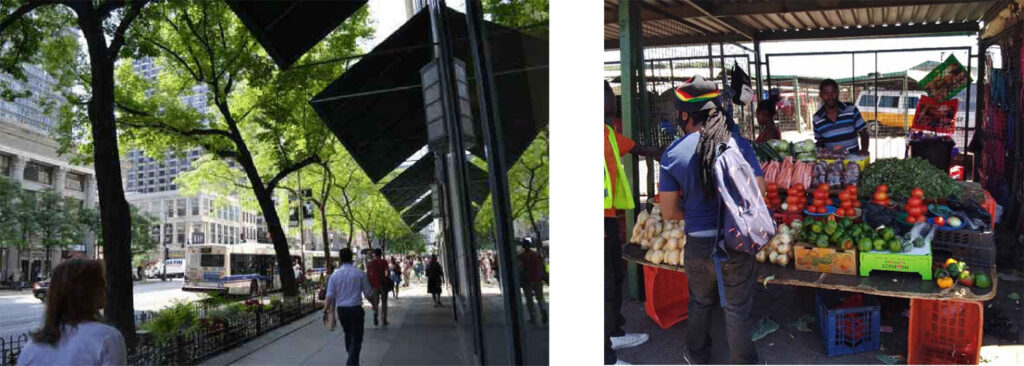
Facades with depth can ensure that the needs of the private individual/occupant of the building and the general public can be mediated. Balconies, terraces, arcades etc. can provide transitionary space in which the occupants of buildings and passers-by can engage. Smooth surfaces also do nothing to retard air flows and can contribute to increased wind tunnel effects along the road network.
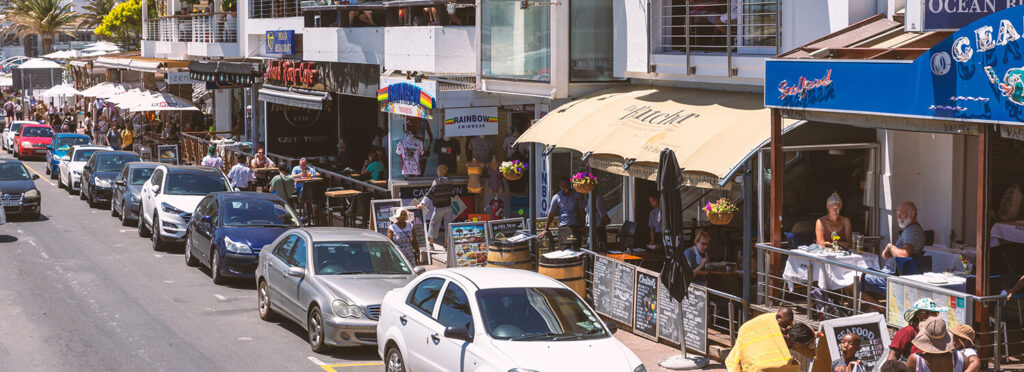
The zone between the building and the road kerb has an important role to play in activating the street domain. In The Heart and along the Activity Corridors it should be used to accommodate controlled street vending, restaurants, cafes, PT infrastructure and informal social activities. It must be an important focus area of the urban design guidelines and layouts as it is the logical place for landscaping.
Figure: Residential edge: A preferred spatial condition

Figure: Mixed-use edge: Land use and activity zones

The guidelines will then provide the necessary details to guide the manufacture of these items.
Built infrastructure such as the toilets, security kiosks etc. are also important potential space making tools and should be included as part of a ‘kit’ of landscape elements to address legibility, safety and useability of the public realm.
The following section provides guidelines at the level of principle to inform the compilation of specific landscape guidelines for the precinct.
Guidelines for tree planting
- Plant at maximum 5m centres and a minimum of 2m away from vertical faces, but this is also dependent on size of adult tree.
- Continuous lines of the same tree species provide strong edge definition.
- The introduction of different species should only be done when there is a need to mark key entrances, significant axis etc.
- Ensure tree planting does not obstruct main NMT routes or sidewalks.
- Trees should be conceptualised as groups/blocks or lines; where feature trees are used they should be reinforced with seating opportunities.
- Trees should be indigenous to Southern Africa.
- Trees should be planted as big as possible to enable the full impact to be understood up front by users of the spaces but avoid ex-open ground tree planting.
- Deciduous trees are appropriate within NMT zones but trees required to providing shade throughout the year should be evergreen. Conversely, where solar penetration is required in winter, rather plant deciduous trees.
- Aim to locate trees close to seating so that people can site in the shade.
- Trees should be surrounded by tree cages where necessary through their first years of development to ensure protection from animals, vandalism and / or wind. Tree cages can be temporary and / or permanent although they all need to be robust, easily replaceable and easily maintainable. Tree cages should be designed to reflect the character of the surrounds. They can be simple and rough but they can also be more sophisticated if they are to be more permanent in nature.
- In particularly dry areas, or where trees will be planted in combination with low planting, consider pioneer trees.
Guidelines for grass:
- Only use grass in less trafficked zones.
- Only use grass when the maintenance of these areas can easily be achieved, inclusive of watering, mowing and fertilising.
- Consider using grass blocks where traffic volumes are not great and where storm-water penetration is preferable.
Guidelines for low planting:
- Create flower beds when the maintenance of these areas can easily be achieved, inclusive of watering, annual thinning, fertilising and replanting.
- Use indigenous water-wise palette of plant material.
- Where possible integrate seating and planting – planter box edges to be widened as seats for example.
Guidelines for vertical planting:
- Carefully select the location – wall space in isolation is not sufficient, also consider orientation and wind exposure relative to the type of planting planned for.
- Select indigenous plants.
- Only undertake vertical gardening when it can be maintained, inclusive of maintenance of the carrier panels, isolation materials, plants and irrigation system.
- Take care that plants do not impede the functioning of the vertical surface on which it is installed, such as rain pipes and gutters.
Guidelines for xeriscaping:
- Select xerophytes (aloe species and similar plants) that require little to no irrigation.
- Note that with the exception of the aloe species, most drought resistant plants still require weekly watering for the first season after planting, to enable plant to develop strong roots and ensure their survival with only seasonal rains thereafter.
Paving guidelines:
- All hardened surfaces are to drain. A 2% fall is sufficient for a surface to drain.
- Make sure pavers are held with an edging and where large areas are brick paved that they are arranged in a herringbone or interlocking pattern to prevent shifting due to heavy use.
- In situ finishes should have expansion joints.
- Brick banding and expansion joints should be used to break up the larger areas of paving and allow the ground plane to be referenced back to an overall grid alignment or the buildings.
- Be careful to create large areas of light-coloured surface as it will create glare. Large areas of dark finishes can contribute to a significant build-up of heat.
- Be careful to specify the correct strength pavers for those surfaces intended to be used by vehicles.
- Sidewalks / pedestrian routes should be a minimum of ±1.8m to allow three people to walk alongside or pass each other and two wheelchairs / prams to pass each other. Minimum dimensions:
- Cycle lanes should be a minimum of ±1.5m.
- When two-way cycling traffic is being catered for a minimum of ±2.5 – 3m is recommended with 0,5m clearance on either side.
Guidelines for bins:
- Bins can be integrated with other elements such as seating or lighting to contribute to increased levels of legibility.
- Bins in the higher order public spaces located adjacent to key public facilities should accommodate recycling.
Guidelines for lighting:
- Lighting can be used to focus flows by identifying key routes and must be used to light changes of level at night.
- Lighting can be used to create atmosphere and illuminate features whether they are built elements, features such as trees, art etc.
- Lighting can integrated into bollards and buildings.
- Remember that reflected light is more effective than a direct light source.
- Lamp posts should be no more than approximately 15-20m apart however the light bulb will need to be specified to achieve this.
- Consider both appropriate lighting for different classes of movement systems and lighting efficiency with reference to SANS 10098-1 (The lighting of public thoroughfares) and SANS 10098-2 (The lighting of certain specific areas of streets and highways).
Guidelines for signage:
- It is important that there is a consistent signage theme used throughout the public space network.
- Signage must not obstruct NMT users. It must be positioned outside of the main flow areas and not be lower than 2.1m if it is within an NMT zone.
- Signage for the visually impaired to be incorporated into broader signage strategy.
- Signage strategy to include temporary signage for events (e.g. flags etc.).
- Avoid clutter of signage that may confuse users.
- Signage should be compliant with all statutory regulations.
Guidelines for seating:
- Prioritise seating along the main pedestrian routes and within the interchange zone.
- Seats must be configured in relation to each other to encourage chance interactions but also to allow individuals opportunities to observe from a distance.
- Recommended seating width is 0.42m and seating height is 0.45m.
Guidelines for bollards:
- Recommended spacing is a minimum of 1.5m.
- Recommended height is minimum of 0.9m and maximum of 1.2m.
Guidelines for bike racks:
- Bike racks must be positioned so that they do not obstruct pedestrian flows.
- Bike racks must consist of a non-removable frame to which a bicycle can be secured without falling over.
- Bike racks must offer 2-point contact for the bike frame.
- The rack should be embedded or surface mounted with tamper-proof bolts to avoid removal of both the rack and take the bikes along with it.
- Select rack materials and coating technology for maximum corrosion and impact resistance.
Public art can provide a means for culture to be expressed, or to define a desired character for the precinct. Public art can create interest and instigate engagement between people who don’t necessarily know each other. It can help to focus attention to a particular point within a space or be used to direct movement and or views, in a particular direction. Public art can activate spaces by encouraging levels of physical engagement of individuals using public spaces, and can serve as a tourism drawcard.
| COMMISSIONED STATUES & SCULPTURES | |
|---|---|
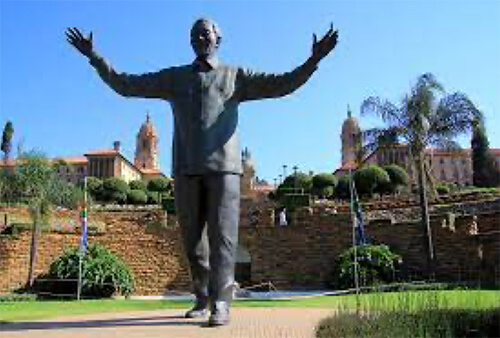
Nelson Mandela Statue, Union Buildings, Pretoria
|
Anton Smit public art installation Menlyn Maine Precinct, Tshwane
|
| COMMUNITY ART | |
|---|---|
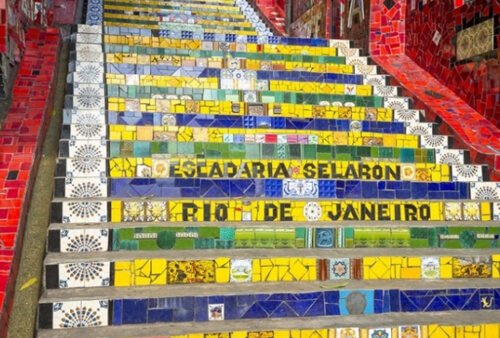
World famous ‘Selaron Steps’ in Rio de Janeiro, Brazil. Jorge Selarón, a local resident, initially started the project to renovate dilapidated steps that ran along the front of his house
|
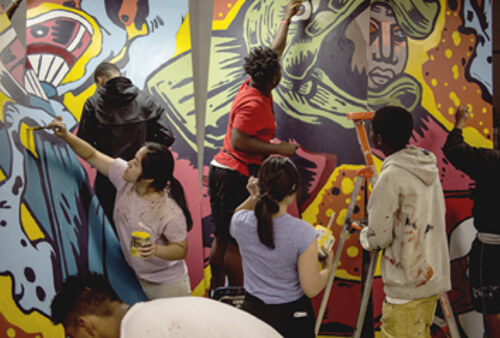
Seattle’s Urban ArtWorks employs, trains, and mentors at-risk community youth. Beginning as a method for clearing the city of graffiti, the group has produced over 400 murals throughout Seattle. Disadvantaged youths earn wages and repay court ordered restitution to their victims. Source: https://urbanartworks.org/
|
- Commissioned works. A professional artists designs and creates the art for permanent public installation.
- Community-based art. This offers communities the means to positively impact their environment and to develop pride and ownership over their public spaces. The city or other entity such as a CID will often provide an artist that functions as a collaborator, interpreter, visionary, teacher, mentor, and liaison between client and community.
- Temporary or pop-up art installations are typically done in those instances where a municipality cannot afford the long-term maintenance of said art, where public art displays support particular festivals, events of other significant days or periods in the community, or where the opportunity is provided for upcoming artists to showcase their works.
Urban art is continually evolving and does not necessarily require commissioning of expensive statutes. Many low-cost urban art initiatives have been demonstrated globally.
| Urban art installations |
|---|
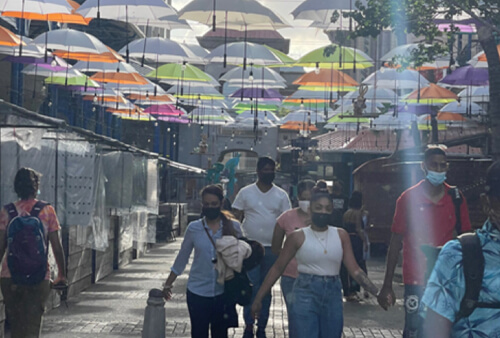
A series of umbrellas have been mounted to form a canopy over a pedestrian throughway. This adds colour and interest, but also serves to protect pedestrians from the sun
|
| GRAFFITI / CHALK AND SIMILAR |
|---|
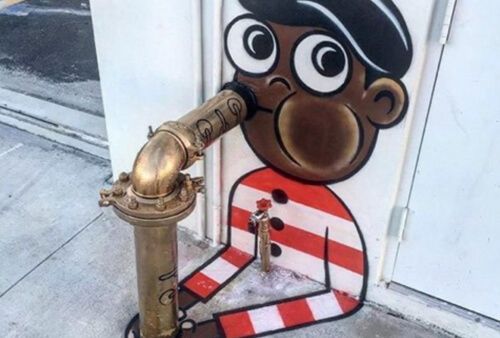
Increasingly, street artists either breathe life into boring urban utility elements, or liven up ugly, protruding items such as drain pipes, adding interest and fun to the urban landscape. Credit: Street artist “Tom Bob” (Pinterest)
|
- General: There should be a fit between the public art and the precinct vision, and the culture, values and aspirations of the local community.
- Lifecycle considerations:
- Proposed art works must be suitable for outdoor display, meaning it must be able to withstand the elements (sun, wind and rain exposure)
- Due consideration must be given to its maintenance and conservation requirements.
- Site selection:
- Consider the relationship of the proposed urban art to the site identified for installation, including to how it will serve to activate or enhance public space.
- Consider the appropriateness of the scale of the artwork in relation to its surroundings.
- Select sites that experience high levels of pedestrian traffic.
- Select sites where the public art will be easily visible and accessible to the public.
- Select sites where the urban art will enhance the overall public realm and will contribute to places of congregation and activity
- Select sites where urban art will function as landmarks and precinct gateways.
- Placement criteria within the selected site:
- Artworks should not be obstructive. Avoid placing art in front of entrances, windows or where it can otherwise impede pedestrian movement.
- Avoid placing artworks in a position that creates blind spots that may encourage anti-social or illegal activity.
- Art should not be placed in a given site if the landscaping and maintenance requirements of that site cannot be met.
- Provide lighting to illuminate public art at night.
- Where possible and appropriate, use local artists.
Guidelines for holistic and integrated design of hard landscaping:
- Select an urban design theme that is consistent with and supportive of the precinct identity, vision, aspirations and objectives, and that is sensitive to local culture and values – and apply this theme to all hard landscaping elements to the extent practicable.
- Design for urban hard landscaping needs to be responsive to the needs of those with disabilities, the elderly, the youth and people with little children.
- Where possible, combine or cluster different hard landscaping elements together, e.g. positioning seating and bins in close proximity.
- Consider hard and soft landscaping together is different but integral, mutually reinforcing components of the public realm.
- Consider asset lifecycle requirements. Wooden benches as urban seating, for example, require maintenance in the form of cleaning, periodic stripping or sanding, varnishing or repainting, and replacement of broken wooden slats. If the municipality is unable to commit to regular maintenance, then rather opt for durable, low maintenance concrete benches.