


Spatial planning
Step 2: Stakeholder identification and development of stakeholder strategies
Objectives
The objectives of this step is to identify stakeholders and their needs, requirements, level of interest and ability to influence the project, and develop tailored stakeholder management strategies.
Why identify and engage stakeholders?
Involving urban stakeholders beyond consultation is a key principle in spatial targeting and planning. This means that urban stakeholders should not merely be consulted, they should actively contribute to the urban design process and beyond, for the following reasons:
- Local community stakeholders (residents, businesses, NGOs/CBOs etc) offer a wealth of insight and knowledge into the character, norms, values, lived experiences (both good and not so good) about the area that will be subjected to urban design – this insight and knowledge enables the urban design team to generate urban designs that reflect and enhance the culture and character of the area, and to attend to difficulties and concerns experienced by the community.
- Engaging with investors and developers is essential. The urban hub precinct design and associated public sector investments are meant to act as catalyst for further private sector investment, without which urban hubs are unlikely to reach their full potential, or, in the case of existing strong nodes, to continue to retain their gravitational and market strength. Beyond the ability to finance private sector investment, investors and developers understand real estate dynamics and urban land markets and are able to make positive contributions towards marketable precinct proposals with improved investment prospects, and to also act as marketers for the precinct.
- Urban design needs to be inclusive and must accommodate the diverse needs of the disabled, the elderly, women, children, the youth, families, and people from a variety of cultures and backgrounds. Involving these groups in the design process significantly improves the robustness and vibrancy of an inclusive urban design. Inclusive design also provides the opportunity to give recognition to the needs, aspirations and potential of informal economy participants such as street vendors.
- An active citizenry that is involved in the urban design process yields many benefits such as deepened urban participation and democracy, a strong sense of belonging, pride and ownership, and active support of the precinct proposals.


Clearly, there are numerous benefits in actively involving stakeholders in urban design. To realise these benefits, it is necessary to identify relevant stakeholders, develop a stakeholder engagement strategy to constructively engage stakeholders using the most appropriate methods at relevant stages, and to utilise awareness tools to generate and maintain interest.
01
Stakeholder identification
The objective is to ensure both early and continuous involvement and participation of stakeholders and communities, leading to improved urban visioning and design, wide support for proposed precinct plans, and an active citizenry that supports and partakes in implementation and urban management. Stakeholder composition may vary from precinct to precinct, but consider the following potential stakeholders, presented in no order of importance:
Table: Possible Precinct Stakeholders
| Stakeholder segment | Stakeholder type | |||
|---|---|---|---|---|
| Public sector |
|
|
|
|
|
|
|
||
| Private sector (formal economy) |
|
|
|
|
|
|
|
|
|
|
|
|
|
|
| Private sector (informal) |
|
|
|
|
| Social sector |
|
|
||
| Community |
|
|
|
|
|
|
|
|
|
|
|
|
|
Stakeholders identified should be classified and recorded in the precinct stakeholder register.
02
Stakeholder engagement strategy
Once stakeholders have been classified and recorded, stakeholder engagement strategies need to be formulated. Stakeholder engagement strategies are informed by the following considerations:
- The level of interest that stakeholders have in the precinct, and the extent to which the precinct plan may impact them;
- The level of influence that stakeholders have in opposing or advancing the precinct development;
- Legal obligations to engage with stakeholders, and the extent of engagement required; and
- The type and level of contributions that stakeholders can offer to the process of precinct planning, implementation and subsequent urban management.
Considering the above, nuanced stakeholder engagement strategies are developed that include the following aspects:
- Objectives and scope or extent of engagement, as well as the expected outcomes and benefits;
- The level of engagement anticipated e.g. information sharing, consultation or active stakeholder involvement in planning and design, to more comprehensive involvement such as co-funding of precinct development;
- Related to the above, the need to create formalised partnerships and relations;
- Engagement methods (see table below);
- Stages or points at which engagement is required;
- Matters related to communication, branding and messaging;
- Feedback to stakeholder mechanisms, formats and frequencies; and
- Ensuring continued stakeholder involvement beyond approval of the precinct plan.
Table: Stakeholder Engagement Options
| Method | Description | Value | Limitations / challenges |
|---|---|---|---|
| Stakeholder/ community meeting | Meeting generally held in a public place to present design proposals to the audience |
|
|
| Planning and briefing workshop |
This type of workshop is held before commencement of urban design. The aim is to establish stakeholder needs and expectations and to cultivate community involvement. This mechanism may be used to:
|
|
Several workshops may be required for large, multi-faceted projects affecting a range of stakeholders. Different views and requirements may be raised at different workshops with various stakeholder groups, without resolution between differing views and requirements in any given workshop |
| Participatory appraisal | Stakeholders/communities share their lived experiences, values, conditions, perceptions and preferences. This involves capable facilitators and the use of visual techniques, discussions, mapping, models and ranking | Provides an in-depth understanding of the needs, challenges, expectations and preferences of stakeholders/communities | The selection of visual and other techniques needs to be well-considered |
| Design workshop (Design ‘charette’, ‘action planning’, ‘planning weekend’, ‘enquiry by design’) | Professional urban designers and stakeholders collaboratively workshop design ideas |
|
The main design activity may take several days, and not all community participants may have the time required to dedicate to the workshop, but can be planned for stakeholders to attend and participate in given time slots |
| Focus group | A fairly small, structured group of stakeholders or people with specific interests, knowledge or experience engaging with a specific topic (e.g. accessible and functional public realm enabling full participation of people with disabilities), guided by a facilitator |
|
|
| Reference group | A forum comprised of municipal officials, stakeholders and possibly experts that acts as a soundboard on issues prior to broader consent processes. It is generally formed before the design stage and generally serves as a consultation mechanism throughout the life of the project. |
|
|
| Surveys | Questionnaire designed to obtain stakeholder inputs (Questionnaires can be paper-based questionnaires, or online polls) |
|
|
There is increasing recognition that the traditional format ofstakeholder or community meetings is not supportive of generating inclusivity, exchange and creativity. There are several reasons for this. Many people find the location, generally a municipal facility, an inconvenient location and setting. The format is generally considered formal and boring. Young people most often do not attend such meetings. Many people are not comfortable speaking out in large gatherings, and conversely a minority of vocal people, who do not necessarily reflect the broad view, tend to dominate discussions.
Given these challenges, several cities around the globe are rethinking community engagements. Increasingly, cities are reaching out to stakeholders and communities, at shopping centers, schools, social clubs and at arranged social events such as picnics, and by arranging planning weekend. City planners and urban designers are also adapting engagement strategies to increasingly encourage active community engagement in a fun way using a range of visual and other techniques. These methods can include for example urban design games, which is an interactive method to engage communities and stakeholders in generating rapid, visual urban design ideas.
Given these challenges, several cities around the globe are rethinking community engagements. Increasingly, cities are reaching out to stakeholders and communities, at shopping centers, schools, social clubs and at arranged social events such as picnics, and by arranging planning weekend. City planners and urban designers are also adapting engagement strategies to increasingly encourage active community engagement in a fun way using a range of visual and other techniques. These methods can include for example urban design games, which is an interactive method to engage communities and stakeholders in generating rapid, visual urban design ideas.
Figure: City at play Urban Design Workshop
Image credit: https://catcomm.org/city-as-play
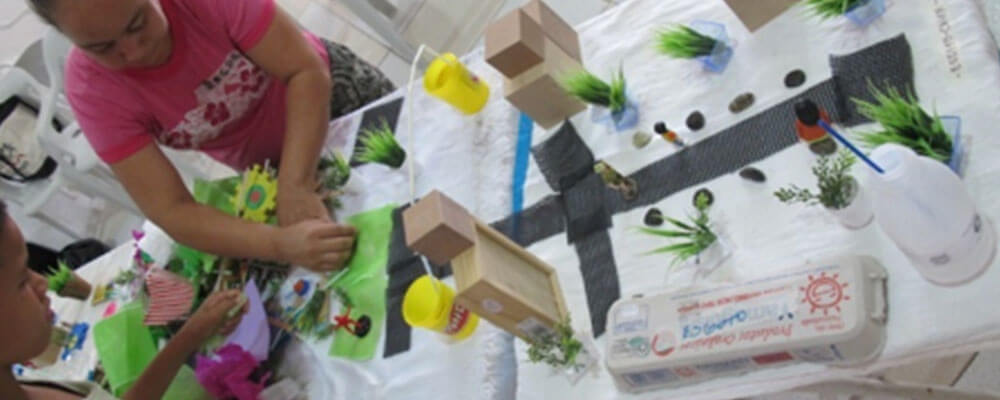
Use everyday materials as design elements to design and construct the precinct, for example wooden blocks of various sizes for the location and height of buildings, and small potted plants and pieces of green paper for green open space.
Alternatively, commercial urban design board games can be purchased or urban designers can create their own board games customised to the precinct being designed. This is done by plotting the cadastral layout of the precinct on an A0 piece of paper, and by preparing cut-out cards of typical design elements, such as options for buildings, streets, sidewalks, cycling lanes, green spaces and landscaping, and public art installations.
Explore more steps on precinct planning and design
Step 1
Precinct identification & definition
VIEW NOW
Step 2
Stakeholder identification & strategy
VIEW NOW
Step 3
Status quo assessment & precinct visioning
VIEW NOW
Step 4
Design the access & movement network
VIEW NOW
Step 5
Develop land use framework
VIEW NOW
Step 6
Urban design
VIEW NOW
Step 7
Plan finalisation
VIEW NOW
Figure: Precinct planning and design

