
How to-banner (1)
Urban Management

Industrial precinct management functions

Towards eco-industrial parks

Precinct management for industrial precincts should be understood within the global trends towards eco-industrial parks. The Department of Trade, Industry and Competition (the dtic) and the National Cleaner Production Centre South Africa (NCPC-SA), in collaboration with the United Nations Industrial Development Organisation (UNIDO), launched the Global Eco-Industrial Parks Programme (GEIPP) in 2020. This programme aims to demonstrate the viability and benefits of greening industrial parks by improving resource productivity and the economic, environmental, and social performance of businesses.

An eco-industrial park is “a community of manufacturing and service businesses located together on common property. Member businesses seek enhanced environmental, economic, and social performance through collaboration in managing environmental and resource issues. By working together, the community of businesses seeks a collective benefit that is greater than the sum of individual benefits each company would realise by only optimising its individual performance.” (Lowe, 2001)

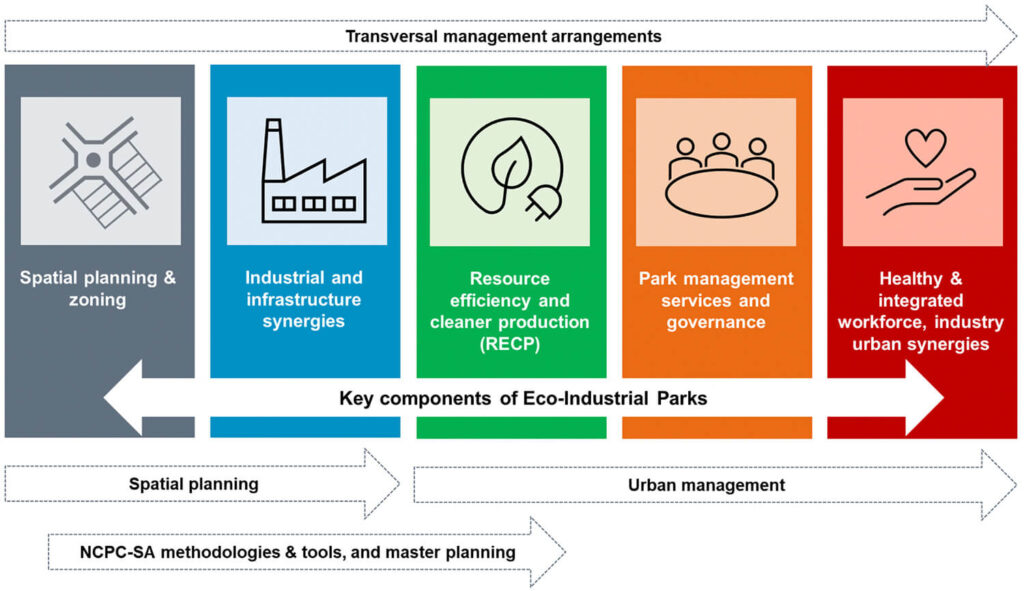
The Eco-Industrial Park (EIP) concept aims to deliver risk resilient industrial parks that are more resource efficient, cost-effective, competitive and attractive for investment. The key components of an EIP are demonstrated in the figure below:

Figure: Components of an EIP
Source: GEIPP South Africa. The dtic and UNIDO (Modified)
EIP park management performance is a core area of focus within the internal EIP framework.
More on the GEIPP and EIPs
The NCPC-SA published the GEIPP booklet and tools for key components of the EIP on its website. Visit to www.industrialefficiency.co.za to access these tools
Framework for industrial precinct management functions
The figure below presents precinct management functions for industrial parks in the following six categories:
  • Core park management services
  • Infrastructure and environmental management services
  • Business incubation and growth
  • Business support services
  • Shared facility provision and management
  • Community development

Clearly this framework of precinct management functions move beyond the basics (core park management services), aiming to provide an environment where park tenants mutually benefit from improved resource efficiencies, synergies, economies of scale, shared facilities, services and know-how, whilst also pursuing improvements in working conditions and investing in local communities – as advocated within the GEIPP programme.
Figure: Industrial precinct management function framework

Core Park Management Services

  • Marketing, branding & investment promotion of the precinct
  • Property development, leasing and/or selling of stands/properties
  • Master planning and zoning (for SEZs)
  • Park / precinct aesthetic guidelines
  • Consideration and approval of building applications (new / alteration)
  • Enforcement of precinct rules
  • Security services
  • Maintenance of communal spaces and facilities
  • Billing (water, electricity and levies)

Infrastructure And Environmental Management

  • Provision of energy
  • Provision of water
  • Wastewater management
  • Solid waste management
  • ICT infrastructure and services
  • RECP assessments, planning and improvements in environmental management
  • Lifecycle management of precinct utility infrastructure, roads and communal facilities

Business Incubation And Growth

  • Arrange regular joint-industry committee meetings
  • Address and find solutions for common challenges and opportunities facing the industrial park and its tenants
  • Coordinate engagement between tenant companies with research and development institutions
  • Arrange training on topics of common interest
  • Support entrepreneurial and supplier development, e.g. for SMEs

Business Support Services

  • Supporting tenants / owners with regulatory applications (e.g. business licenses, import and export permits etc.
  • Support tenant companies in identifying and accessing funding & subsidies
  • Logistics, supply chain management and warehousing services

Shared Facility Provision And Management

  • Shared conference facilities
  • Shared training facilities
  • Testing and prototyping facilities
  • Clinic and associated health services
  • Recreation and entertainment services
  • Emergency services

Community Development

  • Precinct internal social management systems e.g. OHS management systems
  • Local community engagement and dialogues
  • Local community outreach programmes and activities
Scroll to Top